Fredgolm.ai

Computational engineering intelligence at your fingertips.

High-Throughput, Scalable Simulation (The Evaluator)

In configuration space search, your optimization algorithm is only as good as the physics engine evaluating each iteration. Traditional CFD is notoriously slow and computationally expensive, making it a severe bottleneck for rapid design iteration.

  • CFD Acceleration: You need a solver architecture built for modern hardware (like GPU-native CFD solvers) that can run highly parallelized simulations.
  • Surrogate Modeling: To truly scale your search, you cannot run a full Navier-Stokes simulation for every single geometry iteration. You must invest in training AI/ML surrogate models (like Physics-Informed Neural Networks or PINNs) that can predict fluid behavior in fractions of a second, only calling the high-fidelity CFD solver to validate the most promising designs.
  • Automated Meshing: The pipeline must feature completely robust, zero-touch automated meshing. If a complex new 3D geometry causes a mesh failure, the automated search loop breaks.

Intelligent Design Space Exploration (The Navigator)

Aerospace configuration spaces are hyper-dimensional and riddled with local optima. A standard gradient-descent approach will likely get trapped in a slightly-better-than-average design, completely missing the "innovative" leaps you are looking for.

  • Advanced Optimization Algorithms: You need a robust mix of algorithms. Genetic Algorithms (GAs) or Reinforcement Learning (RL) are excellent for broad, global exploration to find entirely novel topologies, while Adjoint-based optimization is perfect for the final, localized shape refinement.
  • Multi-Objective Optimization: Aerospace designs rarely optimize for one thing. Your search engine must elegantly navigate Pareto frontiers—balancing aerodynamic efficiency (L/D ratio) against structural integrity, thermal loads, and weight.
  • Dimensionality Reduction: Identifying which geometric parameters actually drive performance and ignoring the rest will exponentially speed up your search.

Generative Geometry and Manufacturability (The Builder)

It doesn't matter if your math predicts a zero-drag geometry if that geometry breaks the laws of physics or cannot be manufactured. The final pillar bridges the gap between digital data and a physical, aerospace-grade part.

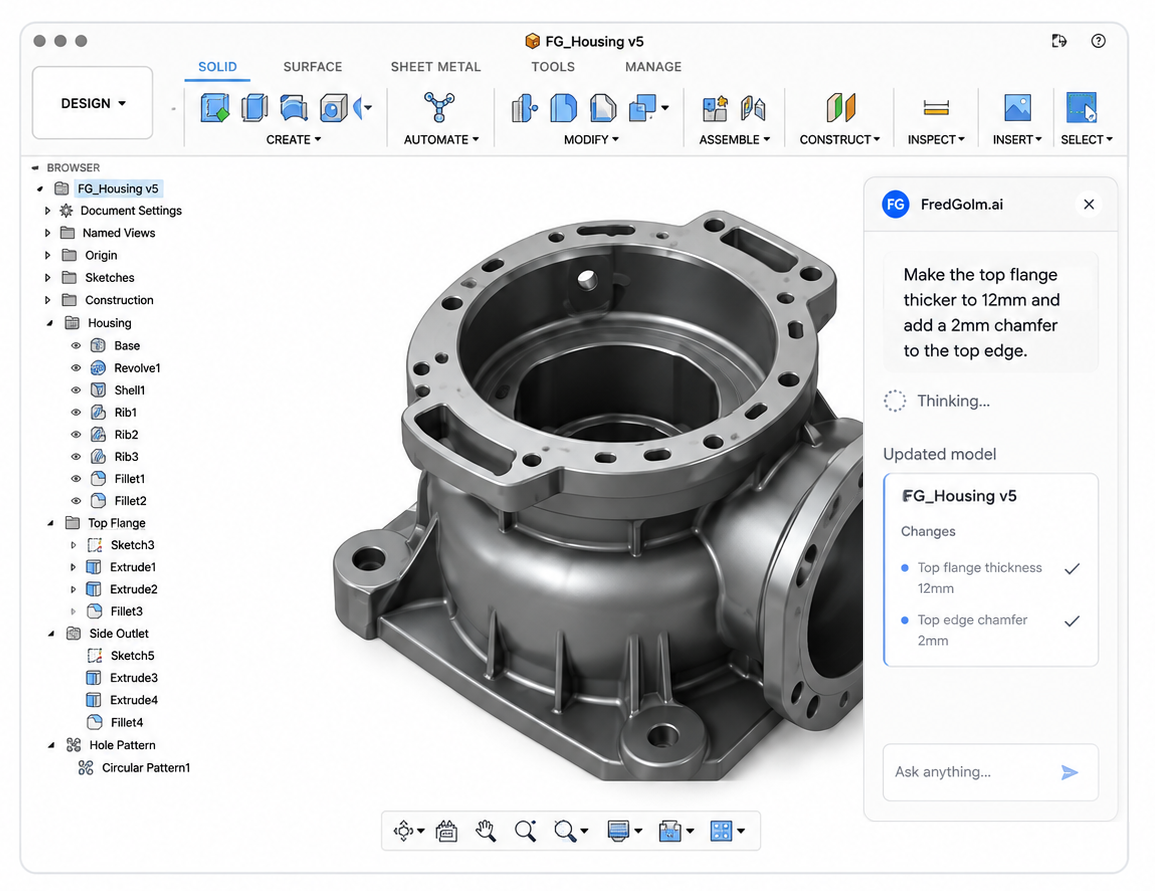
  • Robust Parametric Modeling: Your system needs a highly flexible way to represent 3D geometry mathematically (e.g., volumetric representation, implicit modeling, or advanced B-splines) so the search algorithm can morph the shape continuously without breaking the CAD model.
  • Manufacturing Constraints (DfM): Innovative 3D designs usually point toward Additive Manufacturing (3D printing). Your search algorithm must be penalized for creating geometries with impossible overhangs, trapped volumes, or un-machinable internal cooling channels.
  • Structural and Thermal Coupling: A shape optimized purely for fluid dynamics might snap under aerospace loads. Your pipeline must tightly couple CFD outputs with Finite Element Analysis (FEA) to ensure structural survivability.